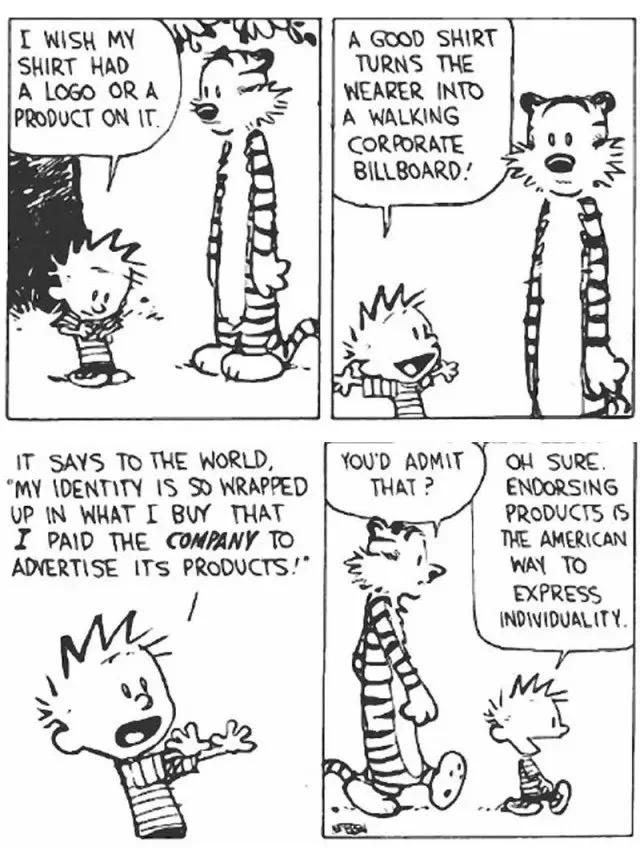
Thanks to Bill Watterson for the timeless classic Calvin and Hobbes. It’s funny because it’s entirely true: people use brands to express their personal identity. What they wear, what they carry, and the businesses they choose to support become a core part of how they show up in the world.
But here’s the critical part most growing businesses completely miss: Branding isn’t just about having a logo. True brand strategy is about making sure the identity your business is already communicating to the market is the correct one.
The Common Misdiagnosis: "I Think We Need a New Logo"
One of the most frequent statements I hear from business owners and event directors is simple: “I think we need a new logo.”
Sometimes, that is mechanically true. But more often than not, what they are actually feeling underneath the surface is a distinct operational shift: Their business has grown, expanded, or scaled—and their visual identity hasn't caught up.
The logo becomes the easiest element to blame because it’s the most visible, public-facing piece of graphic design you own. But changing the icon without fixing the foundation is just putting a fresh coat of paint on dry rot.
4 Signs Your Business Has "Brand Debt" (Not a Logo Problem)
When a visual identity starts to crack under the pressure of a growing company, the real issues are always deeper than a single graphic. If your business is evolving but your presentation feels stuck in version 1.0, look for these four systemic friction points:
Unclear Commercial Messaging: Your team struggles to describe what you do cleanly and without a mountain of industry jargon.
Inconsistent Visual Infrastructure: Your website layout uses one set of fonts, your social media accounts use another, and your physical print materials look like they belong to a completely different company.
A Shifted Target Audience: You are trying to secure premium B2B contracts or high-value regional event partnerships, but your visuals still look like a small, local budget operation.
No Unified Framework: Your identity was built as a series of disconnected, one-off projects rather than a comprehensive, scalable visual system.
A new logo can provide a temporary spark. But long-term brand clarity does the heavy lifting.
Building a System That Handles the Heavy Lifting
When your brand identity framework is working correctly, it creates absolute alignment across every single physical and digital touchpoint.
Your custom website design, your outdoor commercial signage, your 7-foot trade show banners, your tactile 32pt plush business cards, and your internal team voice all point in the exact same direction. That cohesion is what breeds consumer trust and allows you to confidently command premium rates.
If your business has matured but your public presentation is still lagging behind, that gap is the exact signal worth paying attention to.
Let’s Audit Your Brand Infrastructure
Before you spend thousands of dollars on a cosmetic logo swap, let's look under the hood. Let's figure out exactly where your visual communication is leaking leads and build an identity system that matches the true scale of your operations.